About
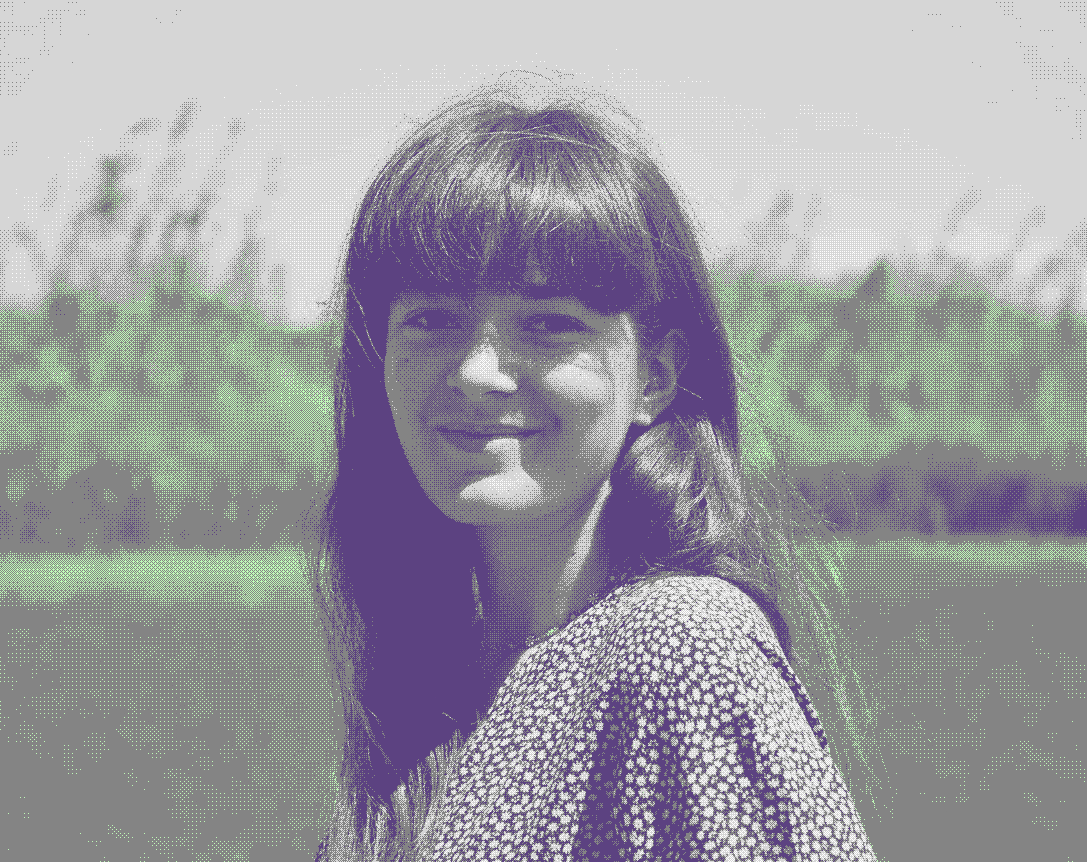
Welcome! I am a PhD student in economics at CREST — École Polytechnique, advised by Prof. Jean-Marc Bourgeon and Prof. Gregory Corcos.
My research interests lie in the fields of environmental economics, international trade and agricultural economics. My work aims to integrate biological processes into quantitative economic frameworks. In particular, I am interested in studying the feedback loop that captures how changes in biodiversity shape and are shaped by economic outcomes. To do so, I rely on both theoretical and empirical approaches, with a special enthusiasm for quantitative trade models and geospatial data.
I am currently visiting the Harvard Kennedy School as a Fulbright Fellow, hosted by Prof. Wolfram Schlenker.
You can find details on my academic background in my CV.
Contact
- Email: chloe.antoine@ensae.fr
- Address: Office 4100, ENSAE Paris, France
Working paper
-
Agricultural productivity and biodiversity effects: theory and evidence
(with Jean-Marc Bourgeon & José De Sousa)
R&R at Journal of Environmental Economics and ManagementAgricultural specialization maximizes land use efficiency but it also amplifies pest pressure, thereby requiring heavy pesticide use. This paper evaluates the economic benefits of using an ecological approach that recommends reducing specialization to leverage natural pest control. We develop a model in which the resilience of a farmer's plot is endogenous to the crop and pesticide choices of her neighbors, which is not internalized. We derive the status quo as well as the socially optimal equilibirum distribution of land between crops. Using disaggregated data and novel instrumental variables, we then estimate the impact of diversification on global crop productivity. Results show that crop biodiversity significantly boosts yields of major crops like maize, rice, and wheat. -
Agriculture, trade and biodiversity
Job Market PaperDoes agricultural trade liberalization erode biodiversity, or can it help preserve it? This paper develops the first quantitative trade model in which biodiversity is an endogenous outcome. Building on a Ricardian multi-country general equilibrium framework with explicit extensive and intensive margins of land use, I embed two ecological sub-modules that translate simulated land-use patterns into long-run species richness and dynamic population abundance. I focus the empirical analysis on birds, which are widely regarded as the premier indicators of overall ecosystem health. I find that the liberalization that took place between 1980 and 2011 has, on average, helped reduce bird species loss globally, primarily by curbing the expansion of low-intensity farming. This aggregate benefit, however, conceals a steep distributional cost: liberalization shifts production toward biodiversy-rich regions, raising extinction risk in some southern ecoregions by up to 34.5%, while northern ecoregions benefit. Trade-induced land-use changes also leave a modest but persistent imprint on bird population dynamics. I further trace the feedback from trade-induced biodiversity change to agricultural productivity and, subsequently, food security and welfare.
Work in progress
-
Ricardo goes green: a quantitative spatial analysis of pesticide regulation's effects
(with Jean-Marc Bourgeon & José De Sousa)Globalization reshapes agricultural production not only by reallocating output across regions but also by intensifying the spatial concentration of crops. This paper develops a general-equilibrium model in which agricultural productivity is endogenously determined through ecological feedbacks. As trade integration lowers costs, countries expand cultivation of their comparative advantage crops, increasing land- share concentration. This concentration heightens pest pressure and reduces yields. Farmers respond by raising pesticide intensity, mitigating yield losses at the cost of greater environmental externalities. The model links trade-driven specialization, pesticide use, and productivity, allowing us to assess how environmental policies can propagate through international markets. In particular, the framework allows us to quantify the welfare and ecological impacts of tighter pesticide regulation in the European Union. -
New evidence on the agricultural extensive margins Agricultural diversification can enhance sustainability by improving resilience to climate shocks and reducing environmental pressures associated with monoculture systems. This chapter constructs new measures of agricultural diversification, capturing the variety of crops produced and exported, for 155 countries over the period 1992–2017. A key contribution is to account for agroecological constraints, which allows for more meaningful comparisons of diversification patterns across countries with different climatic and geographic conditions. Using a gravity framework, I examine how globalization and international agreements have shaped agricultural diversification worldwide.
Talks
-
2026Harvard International Economics Graduate Workshop [Cambridge MA], CESCO Seminar [online], Salata Environmental Economics Weekly Meeting [Cambridge MA], Harvard Environmental Economics Graduate Workshop [Cambridge MA], Duke UPEP Seminar [Durham NC, exp.], RMET Conference [Banff AB, exp.], Big Sky Workshop [Bozeman MT, exp.]
-
2025INRAE SMART Seminar [Rennes FR], EAERE Winter School [Annecy FR], E4C Summer School [Palaiseau FR], CREST PhD Seminar x2 [Palaiseau FR], AMSE PhD Seminar [Marseille FR], EAERE 30th Annual Conference [Bergen NO], BioEcon 26th Annual Conference [Cambridge UK], FAERE 12th Annual Conference [Nantes FR], ETSG 26th Annual Conference [Milan IT], CEE-M Seminar [Montpellier FR]
-
2024CREST Internal Seminar x2 [Palaiseau FR], USSEE 13th Biennial Conference [online], PSAE Internal Seminar [Palaiseau FR], CREST 1st-year PhD Workshop [Palaiseau FR]
Teaching
-
Introduction to economics — École Polytechnique
— Cycle ingénieur, Prof. O. Gossner & J.-B. Michau [Spring 2024]
— B.Sc., Prof. Y. Koriyama & J.-B. Michau [Fall 2023, 2024, 2025] -
International trade — ENSAE
— M.Sc., Prof. G. Corcos [Fall 2023, 2024, 2025] -
International economics — École Polytechnique
— Cycle ingénieur, Prof. G. Corcos [Spring 2025]
Miscellaneous
-
Non-academic interests — In my free time I enjoy watching movies, hiking, reading comic books, cooking vegetarian food, taking photographs and playing the bass. I regularly update this list with movies I like to watch when feeling 'happy-sad'. Currently on repeat: Tennis, Late Night.
-
Website — I'm grateful to Paul Patault for helping me build this website, which design is inspired by that of Gautam Rao. Your visit here produced only 0.05 g of CO2. Check your own website's carbon footprint and learn how to reduce it.
-
Friends — Explore my office mates' research